
Automotive housings have to survive what consumer electronics never sees: continuous vibration, thermal cycling from cold start to full load, road salt, and a service life measured in years rather than upgrade cycles. On top of that, anything the passenger can see has to match the interior trim in colour and texture. We build these to your specification and validation plan — and we are straightforward about what we do and do not certify.
What makes this enclosure difficult
These are the failure modes we see most often in this application — and the ones we design against from the first section drawing:
- Vibration and thermal cycling. A housing that passes bench testing can still crack at a screw boss after thermal cycling if the section has a stress concentration.
- Visible parts must match interior trim. Anodised colour consistency across batches and across different components in the same cabin is a real acceptance criterion.
- Sealing against moisture and salt. Machined seal faces and groove geometry decide whether the IP rating holds after thermal cycling.
- Documentation expectations. Automotive programmes expect dimensional reports, material certificates and traceability that consumer programmes often do not.
How we handle it
Section design that avoids stress concentrations
During DFM review we look specifically at boss roots, wall transitions and corner radii — the places where a vibration-tested part actually fails. Suggested changes at this stage cost nothing; the same change after tooling is cut does not.
Colour matching treated as a specification, not a finish
We work to an agreed colour reference and control the anodising bath and sealing consistently across batches. Our polish-free 6063 process helps here: because the substrate surface is uniform from the billet stage onward, there is less batch-to-batch variation to begin with.
Machined seal faces and grooves
Gasket grooves and mating faces are CNC-machined for flatness and positional accuracy, which is what makes an IP rating achievable after thermal cycling rather than only on a fresh build.
Documentation to your validation plan
Dimensional reports, material certificates and inspection records can be supplied with each batch. We are transparent that we hold ISO 9001 rather than IATF 16949 — if your programme requires IATF-certified supply, we will tell you at the start rather than at PPAP.
Volume capacity with stock holding
For production programmes we can hold extruded profile at our 3,000 m² warehouse and release machined batches against your call-off, which is how most automotive schedules are actually run.
Capability that matters here
| Parameter | Typical capability | Why it matters |
|---|---|---|
| Inner / outer diameter tolerance | ±0.04 mm | Fit and sealing under thermal cycling |
| Wall thickness tolerance | ±0.02 mm | Consistent section stiffness |
| Machined seal face flatness | Around 0.05 mm | IP rating retention after cycling |
| Cut-to-length accuracy | ±0.005 mm | Repeatable line assembly |
| Anodise colour control | To agreed reference standard | Interior trim matching |
| Documentation | Dimensional reports, material certificates | Programme traceability |
Typical parts we make for this industry
- On-board charger (OBC) and DC-DC converter housings
- ECU and domain controller cases
- Centre console and instrument display frames
- Auxiliary lighting and light-bar profiles
- Battery management and distribution boxes
- Charge port and junction enclosures
Material and finish
6063-T5 covers most visible and heat-dissipating automotive housings. Where the part is structural, threaded under load, or sees higher mechanical stress, we specify 6061-T6 or 6082 and re-quote the section for the changed extrudability.
Our polish-free 6063 route runs primary billet from a state-owned mill through ceramic filtration, degassing and homogenising, so the profile goes straight to 180# blasting and anodising with no polishing stage — typically around 15% less finishing cost. We deliberately do not take high-pressure die-casting work; all capacity goes into extruded profile and precision machining.
Questions buyers in this industry ask
Are you IATF 16949 certified?
No — we hold ISO 9001, and we prefer to be upfront about that rather than have it discovered late in your supplier qualification. We can supply dimensional reports, material certificates and inspection records to support your validation, and many customers use us for enclosures where the programme does not mandate IATF-certified supply. If yours does, we will say so at the start.
How do you keep anodised colour consistent across batches?
By controlling the substrate as well as the bath. Our polish-free 6063 route uses primary billet that is ceramic-filtered, degassed and homogenised, so the starting surface is uniform; the blasting and anodising parameters are then held consistently and checked against an agreed reference. For visible interior parts we recommend approving a physical colour standard before production starts.
Can you support prototypes before production tooling?
Yes. CNC-machined prototypes from solid bar let you complete fit, thermal and vibration validation before a die is cut, and we move you to extrusion once the design is frozen. This is the normal path for automotive programmes.
Where we ship these
Other industries we serve
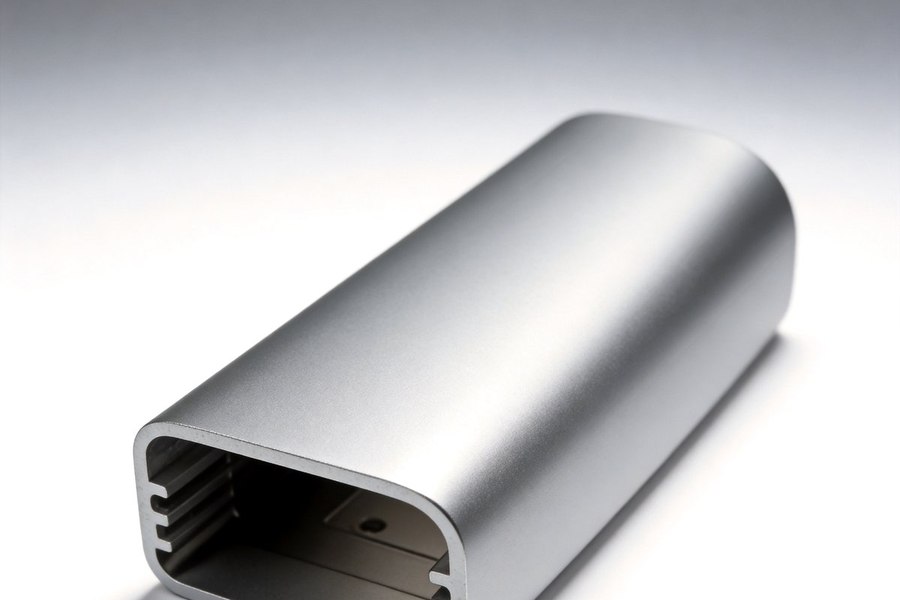
Heat Sink & Thermal Enclosures
Extruded aluminium heat sink enclosures with 0.3 mm fins, machined mounting faces at 0.05 mm flatness and polish-free 6063…
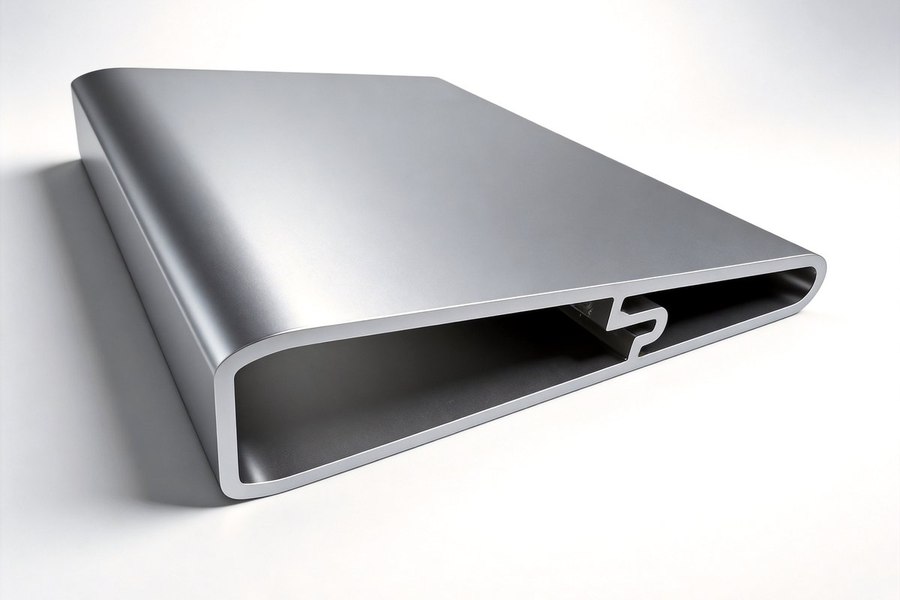
Energy Storage & Battery Enclosures
Extruded aluminium enclosures for portable power stations, home storage modules and BMS control boxes — 0.5–2.0 mm walls, ±0.005…
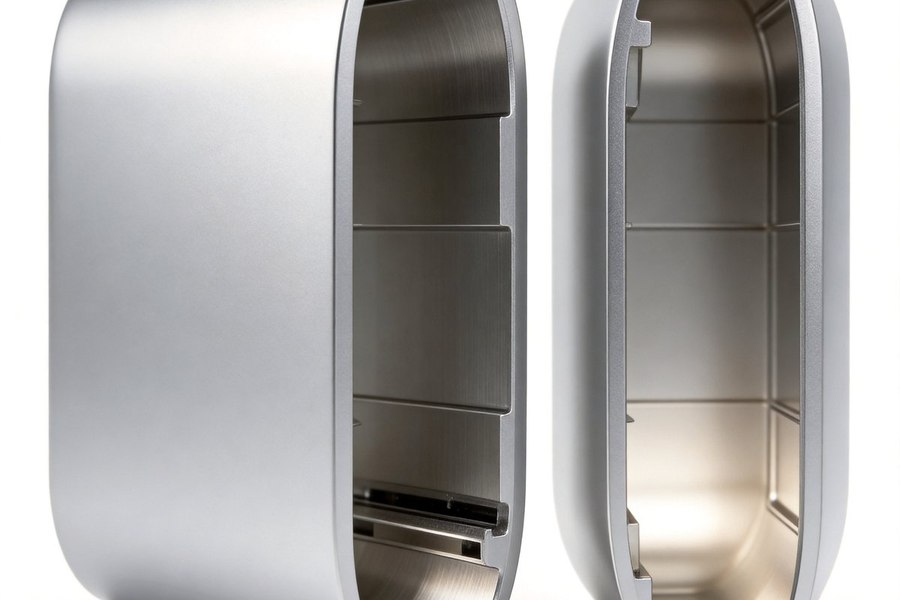
Optical Module & 5G Telecom Enclosures
Tight-tolerance extruded enclosures for 400G/800G optical modules, 5G AAU heat sinks and baseband units — ±0.04 mm bores, 0.3 mm…
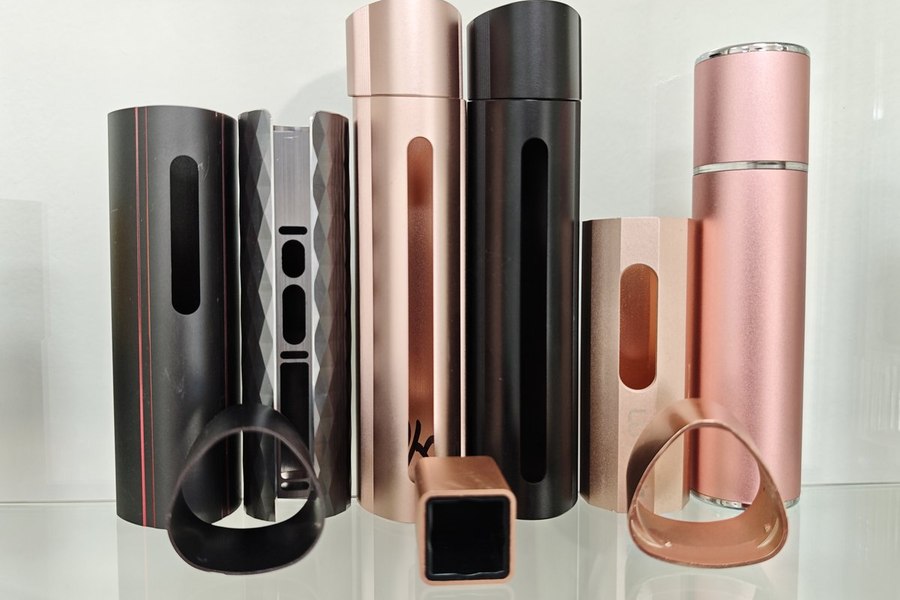
Medical & Beauty Device Enclosures
Cosmetic-grade aluminium housings for beauty instruments, hair styling tools and portable medical devices — polish-free 6063,…
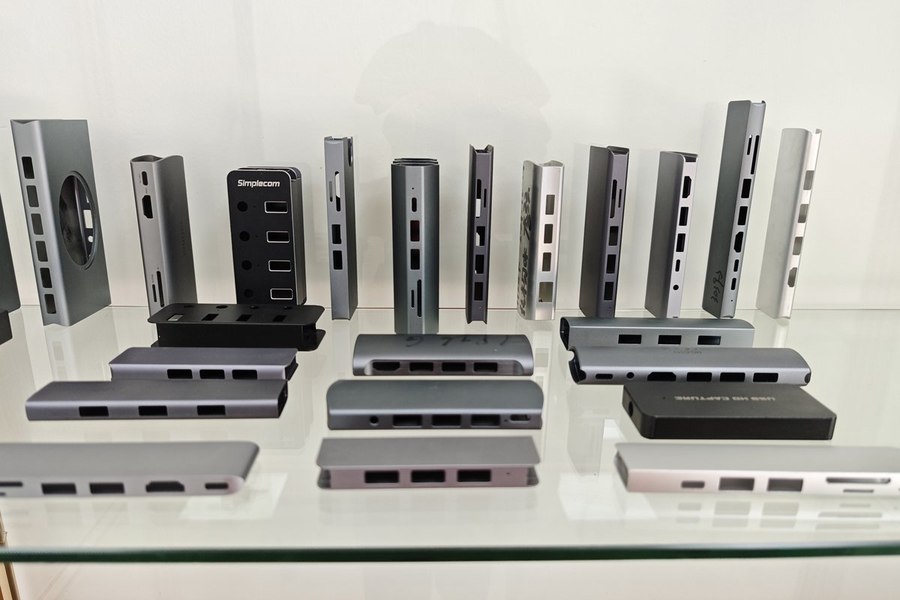
3C Consumer Electronics Enclosures
High-volume aluminium shells for external SSDs, docking stations, power banks and wireless chargers — ±0.005 mm cut-to-length…
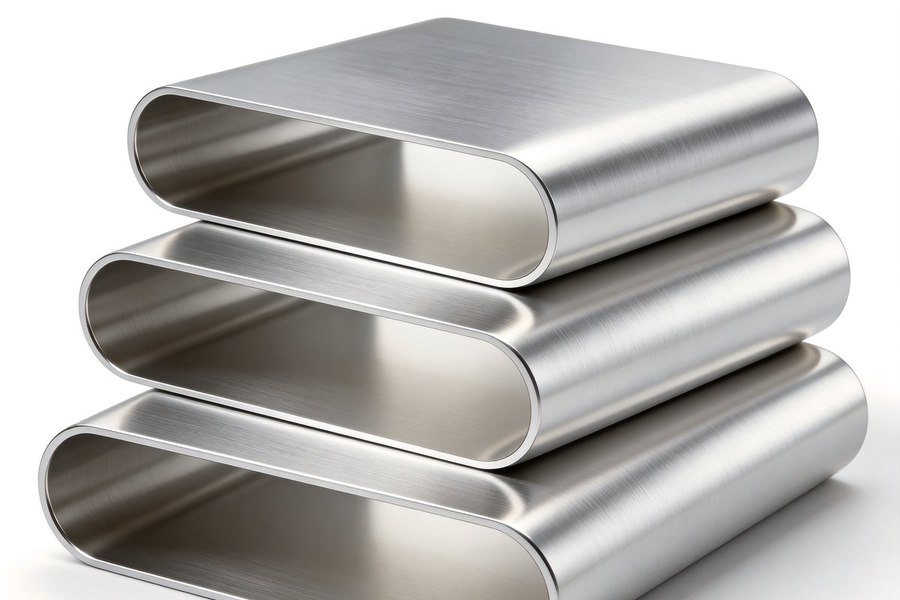
Industrial Control & Instrument Enclosures
Extruded aluminium housings for PLC controllers, HMI panels, sensors and test instruments — machined cut-outs, grounding…
Send your housing drawing and validation requirements — we will confirm what we can support and quote tooling within one working day.