
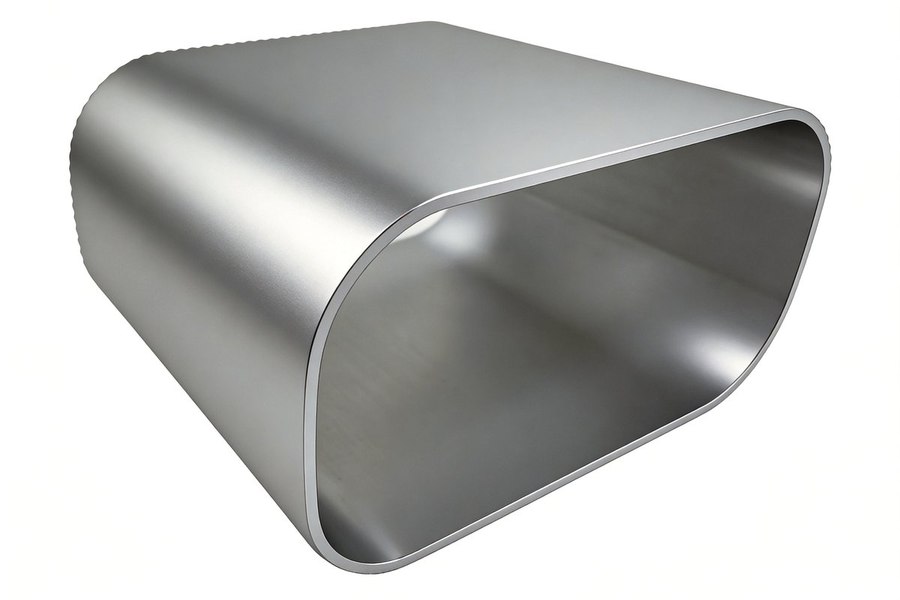
One question decides it: does the section stay constant along the length? If it does and the volume is real, extrude. If the geometry changes on every face, machine it. Here is the short version, with the shop-floor numbers behind each answer.
Both processes run on the same floor here, so we are not steering you towards whichever machine happens to be free. What follows is the check we actually run during a quote review — five lines, in order.
The 30-second check
| Ask | Answer | Route |
|---|---|---|
| Does the cross-section change along the length? | Yes | Machine from solid |
| Annual volume | Under about 500 | Machine |
| Annual volume | Over about 1,000, section constant | Extrude, then machine the interfaces |
| Walls thinner than 1 mm | Required | Extrude — 0.3 mm is routine |
| Design not frozen yet | True | Machine the prototype, cut the die later |
Extrusion: what the press can actually do
- Two presses: an 1,800 t R1800 for sections up to a 220 mm circumscribing circle, and a 700 t R700 for smaller thin-walled profiles.
- Maximum profile weight 4 kg/m, cut to 6 m lengths.
- Walls down to 0.3 mm — usually the reason extrusion gets asked about at all.
- A new die in 7–10 days; the fee is waived at 2 tonnes.
- Screw bosses, card guides, PCB slots and heat-sink fins cost nothing extra once they live in the die.
CNC: what the machines can actually do
- 30 CNC centres — 5 five-axis, 10 four-axis, 15 3+2.
- ±0.04 mm routine, ±0.02 mm on wall thickness on request.
- No tooling: a first article can come off the machine in days from a STEP file.
- Handles what extrusion cannot — tapered bodies, angled faces, pockets on several planes.
In production it is usually both
Extrude the body, then machine the end faces, connector cut-outs, display windows and threads. That is how most of the enclosures we ship are built: the large repetitive geometry rides in the die, and spindle time is spent only where a tolerance actually changes the outcome.
Two misreadings that cost money
- “Extrusion is always cheaper in volume.” Only when the geometry lives in the die. A profile that still needs five faces milled afterwards is barely cheaper than a solid part.
- “Machining is always faster.” Faster to first article, yes. Slower to 5,000 units, by a wide margin.
Two quick answers
Which is cheaper at 500 pieces?
Machining, usually — the die has too few parts to amortise against. Between 500 and 1,000 the answer depends on part size and on how much still has to be machined after extrusion.
Can I avoid tooling entirely?
Only by machining. Any extruded enclosure needs a die for its section; what you can avoid is paying for it before the design is proven, and paying for it at all above 2 tonnes.
How we run a new programme
Prototype quantities are machined from solid bar so fit and finish can be validated with no tooling spend. Once the design is frozen and the volume justifies it, the part moves to extrusion — and a single order of 2 tonnes waives the die fee outright. See how this played out in our case studies.
Have a project in mind? Send your drawing and get a DFM review plus tooling quote within one working day.