
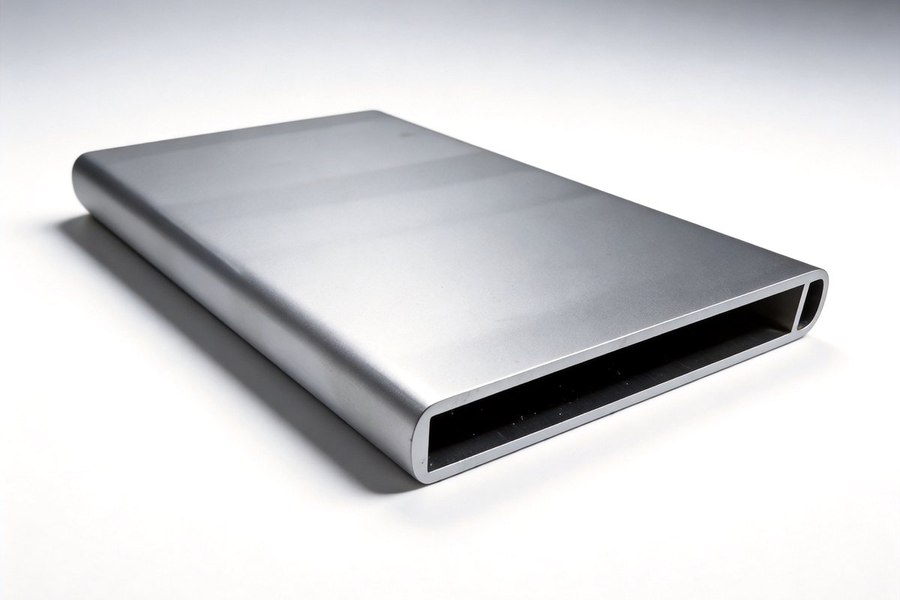
Anodizing converts the aluminium surface itself into an oxide layer. Powder coating lays a polymer film on top of it. Every practical difference — conductivity, heat path, chipping, dimensional change — follows from that one fact.
Surface treatment is where an enclosure either reads as a precision product or as a painted box. These are the two finishes we apply most, and they are not interchangeable.
One grows, the other deposits
Anodizing drives an electrochemical reaction that grows aluminium oxide out of the substrate, 5–25 µm for Type II and 25–50 µm for Type III hard anodizing. Nothing is added, so there is no film to lift — a scratch shows as a bright line in metal, not as a flake. Roughly half the film grows outward, so a 10 µm coat moves each face about 5 µm.
Powder coating sprays electrostatically charged polymer onto a grounded part and cures it at 180–200 °C, leaving a 60–120 µm film sitting entirely on top. It hides tool marks and substrate variation and takes almost any colour, gloss or texture — and everything it adds is an electrical and thermal insulator.
Four hard differences
| Property | Anodizing | Powder coating |
|---|---|---|
| Electrical path | The oxide is a dielectric; the metal conducts only where it is left bare or converted | Insulates completely |
| Thermal path | Micron film, negligible resistance — fins keep working | 60–120 µm of polymer blocks heat transfer |
| Chip / peel | Integral to the metal, cannot peel | Resists abrasion, chips on impact and exposes bare metal |
| Dimensional change | About 5 µm per face at 10 µm | 60–120 µm per surface, up to 0.24 mm across a bore |
What each is actually best at
- Anodizing: heat-sink faces, cosmetic shells handled daily, bores and threads held to ±0.05 mm, and any surface that must stay dimensionally stable.
- Powder coating: outdoor housings facing salt and UV, brand colours that anodizing cannot reach, matte and textured finishes, and covers that need to hide substrate marks.
- Both on one part: anodised body with powder-coated visible panels — provided the masking drawing says exactly which faces stay bare.
The 10-second rule
Does the surface have to conduct, cool, or hold a tolerance? Anodize it. Does it have to weather, match a colour, or hide something? Powder coat it. If the answer is both, the part needs two processes and a masking drawing, not a compromise.
Still deciding? Our surface treatment FAQ lists every option we offer, including conductive oxidation for EMI.
Have a project in mind? Send your drawing and get a DFM review plus tooling quote within one working day.