
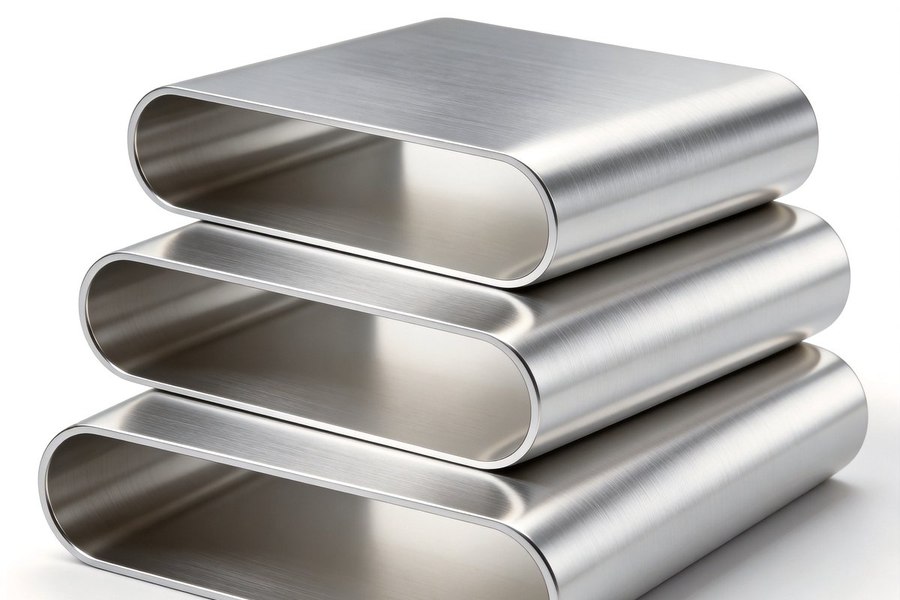
Inside the tooling stage of a custom aluminium enclosure — die layout, bearing length, solid versus hollow sections and how the first sample is proven.
Between your drawing and your first sample sits the extrusion die. It is the cheapest moment to fix a design problem and the most expensive one to find afterwards, so it is worth knowing what happens inside those four to five days.
From cross-section to die layout
An extrusion die is a hardened steel disc with an opening shaped like your cross-section. The die designer's job is to balance metal flow: the bearing length — the land the aluminium rubs against as it exits — is longer where the section is thick and shorter where it is thin, so every part of the profile leaves the press at the same speed. Get that balance wrong and the profile twists, ripples or tears.
Solid, semi-hollow and hollow sections
- Solid sections are the simplest and cheapest dies — no mandrel and no weld lines.
- Semi-hollow sections use a port-hole die and the metal re-joins under pressure, leaving a weld line we keep away from cosmetic and sealing faces.
- Hollow sections with closed chambers need a mandrel held in the metal flow; feasible, but only where the chamber is large enough for the metal to knit cleanly.
What we decide before cutting steel
| Die decision | Driven by | What it changes |
|---|---|---|
| Bearing length per face | Wall thickness and local metal volume | Straightness and surface finish |
| Weld-line position | Lid joint and sealing land location | Where a visible line may appear |
| Corner radii and fillets | Cosmetic faces and machining stock | Die life and anodise quality |
| Tolerance class | How critical each feature is | Die cost and scrap rate |
Proving the die
Once the die is cut we run it and inspect the first lengths against the drawing — wall thickness, straightness, twist and surface. Because three rounds of free sampling are included, a wall or fillet that needs a tweak is corrected before you commit to production. Tooling recovery is explained in our lead-time FAQ, and you can see how volume writes off tooling in the case studies.
Send the cross-section and target volume and our die engineers will flag any feature that will not run cleanly before you pay for tooling. Start with a free DFM review.
Have a project in mind? Send your drawing and get a DFM review plus tooling quote within one working day.