
Standard anodizing is an insulator, which becomes a problem the moment the enclosure has to pass EMC. The fix is not to strip the whole box back to bare metal — it is to decide which faces have to conduct, and treat only those.
An aluminium oxide film is a dielectric 5–25 µm thick, sitting exactly where the gasket and the grounding lug need to make contact. The enclosure looks finished and fails radiated emissions. What follows is the set of options we specify, and when each one is the right call.
Make the joint conductive, not the box
Aesthetics and conductivity want opposite things. The outer skin wants a sealed, dyed anodic film; the seam wants bare or converted metal. In practice that means a masking drawing: the visible faces stay anodised, the gasket lands, the ground studs and the shielding shoulder stay conductive.
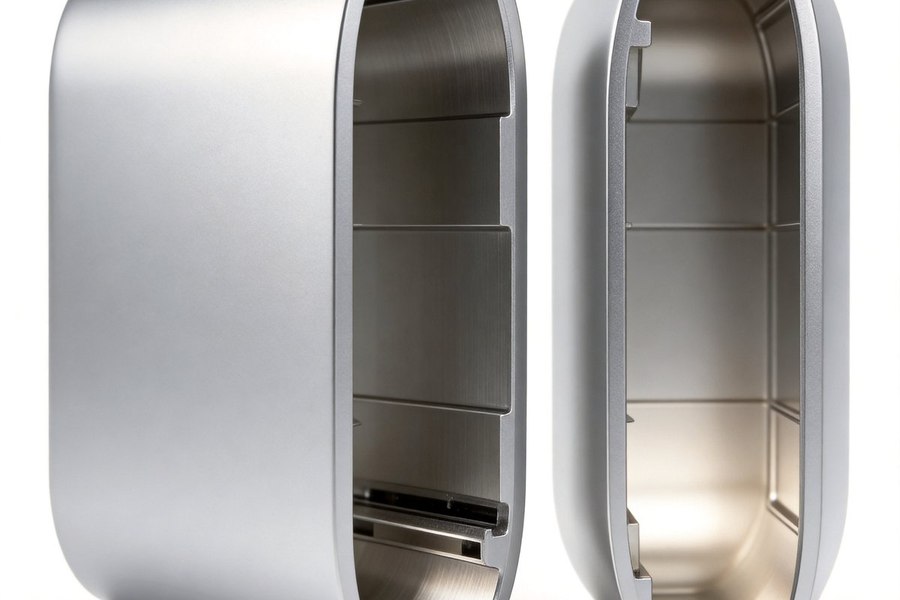
The most robust arrangement machines a continuous shielding shoulder into the profile itself, so the gasket always lands on a machined face rather than on a coated one, whatever the finishing shop does.
Five ways to restore contact
| Method | What it gives you | Use it when |
|---|---|---|
| Chemical conversion coating (chem film) | A thin, conductive, corrosion-resistant film, typically specified to MIL-DTL-5541 | The whole contact face must conduct and stay corrosion-resistant — the default choice |
| Selective masking before anodising | Bare aluminium on the land, anodised everywhere else | The part is already being anodised and only a narrow land needs to conduct |
| Machining the land after finishing | Bare metal, cut after the film has grown | The land is a critical flat face and masking would disturb the finish edge |
| Electroless nickel on gasket lands | Harder, more stable contact surface with higher attenuation | Repeated open/close cycles, or a gasket that abrades the land |
| Conductive paint or plating on plastic covers | Shielding on a non-metallic lid | The cover is not aluminium but still has to close the seam |
Which one, and why
- Chem film is the default because it is applied after machining, covers the whole face, and does not change dimensions. It is also the only option that protects the contact face against corrosion while conducting.
- Masking is cheaper per part but it is hand labour, and the mask line is a place where finish quality varies. Good for a narrow land on an already-anodised part.
- Post-machining guarantees a flat, bare land and is the most reliable for a sealing surface that also has to conduct — at the cost of an extra operation and an exposed edge that needs protection.
- Nickel earns its cost where the enclosure is opened often, or where a fabric-over-foam gasket would wear through a thin conversion film.
The gasket is part of the electrical design
Contact resistance is set by the gasket as much as by the finish. A conductive silicone or fabric-over-foam gasket needs a located groove with controlled compression — the same 20–30% that a sealing gasket needs, because over-compression crushes the conductive filler and under-compression leaves an air gap. Fastener pitch along the seam should stay at 25–50 mm; wider spacing lets the lid lift and turns the joint into a slot antenna.
Two ordering mistakes
- Specifying "conductive anodising". There is no such finish — anodizing is an oxide, and oxide is the insulator. What is meant is usually chem film, or anodising with masked lands.
- Leaving the contact faces off the drawing. The finishing shop finishes what it is told to finish. If the mask is not drawn, the land gets coated and the part fails at EMC, which is the most expensive place to find out.
Send the EMC target with the drawing
Tell us the attenuation you need, the frequency range and where the joints sit, and we will propose the contact finish, masking scheme and gasket groove that still work after assembly. Our FAQ covers the substrate and finish combinations we run in-house.
Have a project in mind? Send your drawing and get a DFM review plus tooling quote within one working day.